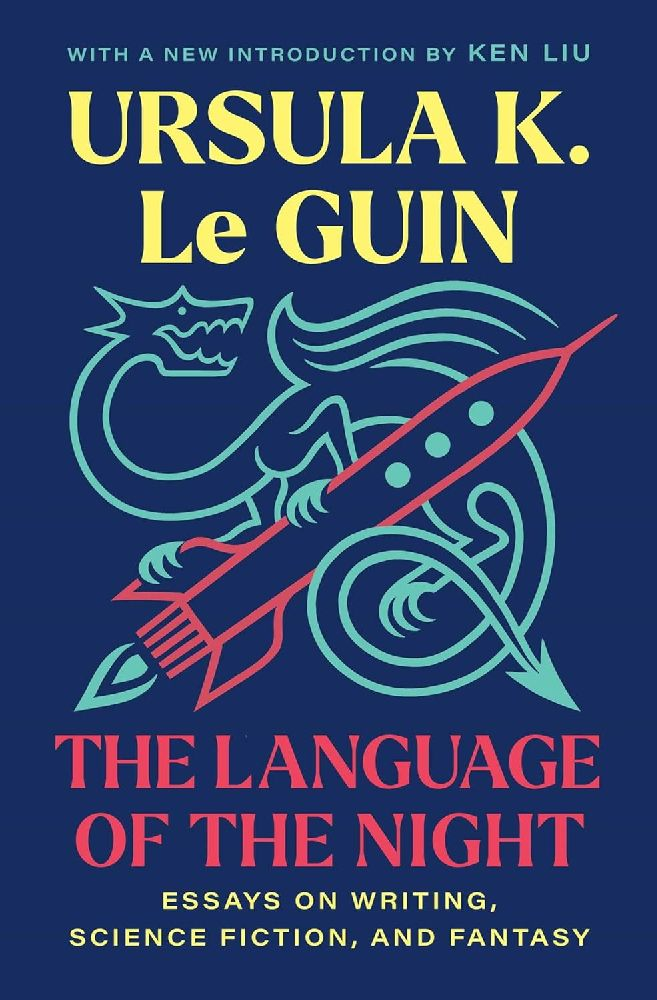
I received a review copy of this brilliant book from NetGalley and Scribner, and could not be more appreciative!
“…the pursuit of art…by artist or audience, is the pursuit of liberty.” -Ursula K. Le Guin
Ursula K Le Guin was a master storyteller. Her work has entertained and enthralled thousands of readers for six decades. I knew her primarily as a SciFi author; this collection of brilliant essays has introduced me to a new Ursula Le Guin, even more talented than I had imagined.
As the subtitle implies, Le Guin discusses her writing craft as well as her thoughts as a writer of SciFi and fantasy. She also discusses feminism, gender, politics, literary criticism, psychology, sociology, and so much more. I had requested this book as a writer looking to learn from one of the greats; I finished the book as a student of the Humanities. I was enthralled while reading her thoughts and took pages of notes. It has taken me too long to write this review; I honestly didn’t know where to begin.
Imaginative fiction is often considered to be frivolous, silly work that should be left behind as we become adults. (Try telling that to the hordes of Dark Fantasy and Romantasy fans of the world, I dare you.) Le Guin emphasizes the importance of imaginative fiction: “Those who refuse to listen to dragons are probably doomed to spend their lives acting out the nightmares of politicians. We like to think we all live in daylight, but half the world is always dark; and fantasy, like poetry, speaks the language of the night.” Allowing ourselves to experience the make-believe world enables us to manage the real world. If we can dream, we can do.
“The story […] is one of the basic tools invented by the human mind, for the purpose of gaining understanding. There have been great societies that did not use the wheel, but there have been no societies that did not tell stories.” Storytelling is the history of humankind, and its future. Without stories, we would not exist.
When discussing the value of faerie stories, Le Guin stresses “Children’s imaginative play is clearly a practicing at the acts and emotions of adulthood; a child who did not play would not become mature,” and “The use of imaginative fiction is to deepen your understanding of your world, and your fellow men, and your own feelings, and your destiny.” To read fiction is to imagine who we can be, Le Guin says.
Ursula Le Guin believed “…that maturity is not an outgrowing, but a growing up: that an adult is not a dead child, but a child who survived. I believe that all the best faculties of a mature human being exist in the child, and that if the faculties are encouraged in youth, they will act well and wisely in the adult, but if they are repressed and denied in the child they will stunt […] the adult personality.”
In discussing feminism, Le Guin said, “One of the great early socialists said that the status of women in a society is a pretty reliable index of the degree of civilization of that society.” I wonder what that person would think looking at today’s world. Le Guin doesn’t shy away from the faults within her own genre of choice: “Isn’t the “subjection of women” in SF merely a symptom of a whole which is authoritarian, power-worshipping, and intensely parochial?” In other words, art imitates life, and we need to do better. As Le Guin succinctly said, “I didn’t see how you could be a thinking woman and not be a feminist.”
“The Language of the Night” claims to be a book about writing, and it is. It is a book about writing as a means to authenticate life.
 This is the Mask