As usual, I have managed to read faster than I write, and I have fallen behind on my NetGalley reviews. Here is a handful for you to peruse and see if any appeal to you. More are to come over the next few days!
***
Traversal by Maria Popova
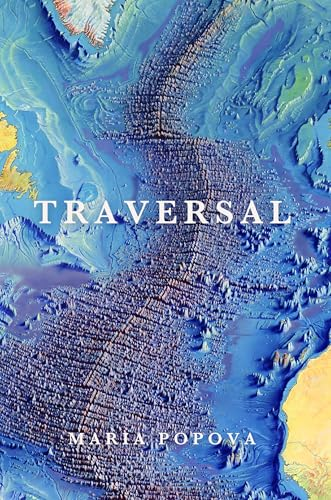
I have been a fan of Maria Popova’s work for years. I’ve been a faithful reader of her newsletter “The Marginalian” for twenty years. Popova never fails to both delight and educate me with every issue, and when her first book “Figuring” was announced I ordered it without bothering to read the synopsis. The same goes for her latest book “Traversal.” Popova’s brilliance and meticulous research shines on every page whether she is discussing the poetry of physics or the physics of poetry. Her writing on the juxtaposition of art and science leads readers into labyrinths of the heart and mind.
“Traversal” takes readers from Captain Cook’s first command to astronomer poets bewitching students in a college lecture hall to teenage runaways trekking across France before hiding out with Byron in Italy in the Year Without a Summer. Readers return to a more present-day England where Dorothy Crowfoot Hodgkin is studying the crystalline structure of insulin and being denied an American visa because she had the audacity to support world peace in the American McCarthy era. Subsequently, she was awarded the Lenin Peace Prize in Moscow.
Popova writes of Shelley’s grandiosity and Frederick Douglass’ flight to freedom and scorn and dismissal of his own wife and Karl von Drais’ meteorological experiments. We compare the tragic suicide of Mary Shelley’s sister Fanny Imlay to Walt Whitman’s heartbreaking loss of his true love Fred Vaughan, interwoven with Margaret Mead’s studies of Samoan culture and experiments in free love. Throughout all of this, the people, the science, the search for meaning and truth and planetary transits and creations of lasting literary masterpieces is Popova’s message of the preciousness of the lives we are given and how much each life is of value to the whole of humanity.
I cannot recommend this book enough. Please read this. And when you have finished, read Popova’s book “Figuring.” You will not be disappointed.
***
Afternoons of Suspended Love by Stefania Lucchetti
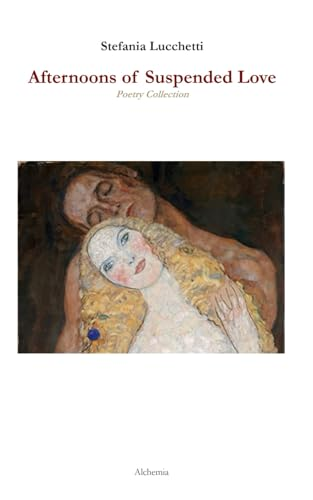
“Afternoons of Suspended Love” is the second book by Stefania Lucchetti I have had the pleasure of reading, and just like “Coffee Stains on My Books,” I was captivated. Reading Lucchetti’s writing is like reading one’s own diary entries: truthful, sensitive, hopeful, sad, and joyful. The title poem makes me think of a couple settled into comfortable companionship. There isn’t excitement every day, but there is the warm knowledge of each other, and that is everything. In “Love Language” she says: “[…] In small things, I find your affection/ in everyday gestures, your direction. / As I sip my coffee, / I feel your presence beside me.”
“Recycling” is a poem that is reflected by many couples, I think. No relationship is ever perfect; we have to keep trying so we don’t waste what we have; and in “Constant Mystery,” I feel Lucchetti has perfectly presented the true definition of what love is: “[…] Love requires presence, / and sometimes space, / steadfastness, listening, / and patient grace.”
My favorite in this collection is “Love Me.” It is a beautiful poem, saying “love me, just because”: “[…] Love me for no reason, /or for every ancient rhyme, /to hear the echo of forever, /and forget the fleeting touch of time.”
***
Love & Other Monsters by Emily Franklin
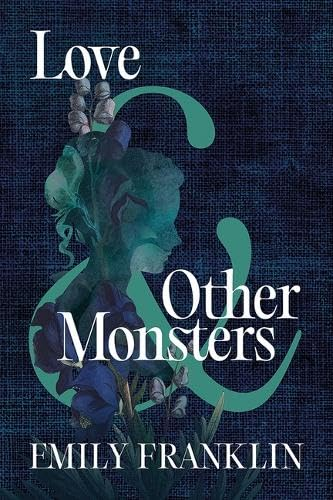
Knowing that this is a novel featuring historical figures I understand that the story wouldn’t be factual and I was fine with that. I was expecting to like this novel as I am a fan of both Mary Shelley and the terrible person that was Lord Byron (you can separate the art from the artist, but it is difficult). Unfortunately, I feel this book fell completely flat. The story itself is good; the plot is solid and could be engaging if I didn’t dislike every principal character. I know this is Claire’s story and not Mary’s, which I genuinely appreciated, but all of the characters, Claire included, feel very one-dimensional, like reading a narrative about playing with paper dolls. I haven’t given up on this book; I am going to read it again to see if my perspective will change, but at present it is not a favorite.
***
Dancing Through Seafoam by Diane Skye Gropper
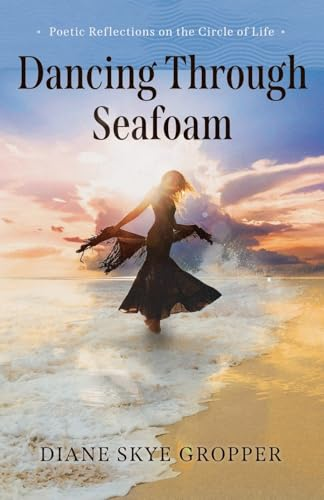
“Dancing Through Seafoam” is Diane Skye Gropper’s debut poetry collection. In it she reflects on the past and navigates the present with the sea as a guiding presence. I understand the direction her work takes but could not connect to it. I think as her work progresses so too will her message, and the meaning of her thoughts will become clearer and more engaging to readers.
***
The Size of Your Joy by Elise Powers
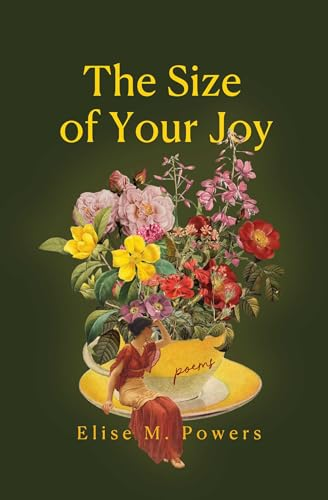
Elise Powers writes masterful poetry. Her work touches your soul, igniting emotions you may have suppressed. She doesn’t pull her punches; she invites readers (or forces them) to examine loss and grief and anger and desperate love. “Things Men From the Internet Have Said to Me” is every woman’s experience, both online and in person.
I experienced the same bizarre reality of sameness Powers speaks of in “My Grandmother is Dead and I’m Standing In Line to Buy Chicken” after my own beloved grandmother passed. I remember wondering how things could be so normal after I had lost someone so precious to me. As a person with a traumatic past, I recognized my own behavior in “Inventory of Unnecessary Apologies.” Like Powers, I have been conditioned to apologize for existing. In “Savage” she defines how it feels to be a mother: “[…] learning how to live with your heart beating helplessly outside your body;” and relates how painful and beautiful parenting is in “Every Day, Preemptively.”
I was delighted to have found another collection with a Golden Shovel poem, this one inspired by Mary Oliver. Elise Powers has studied the masters, and it shows. I am looking forward to reading more of Powers’ work.
***
Odessa by Gabrielle Sher
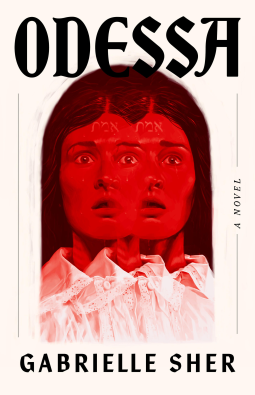
This book was everything I look for in a Gothic story. Darkness encroaches on the people of the shtetl, already living under the oppression of the Gentiles, a darkness bred by a people struggling to survive and a father’s grief. The character Yetta is the perfect Gothic heroine: she faces seemingly insurmountable odds, yet her intelligence and bravery enable her to clear a path through the woods surrounding the village and her life. As much as this is a story of darkness and revenge, it is also the story of a mother’s unconditional love and the bond that sisters develop. This book had me in tears and on the edge of my seat at turns. I think I can safely say this is one of the best books I have read so far this year, certainly the best work of fiction thus far.
Gabrielle Sher creates living scenes: you feel the chill in the air, you see the shadowy, run-down buildings of the shtetl. The fear of her characters is palpable, as is Yetta’s anger and Frieda’s unrelenting love for her children. I wasn’t sure where Sher was going with the ending, but it wrapped up the story perfectly.
***
How Flowers Made Our World by David George Haskell
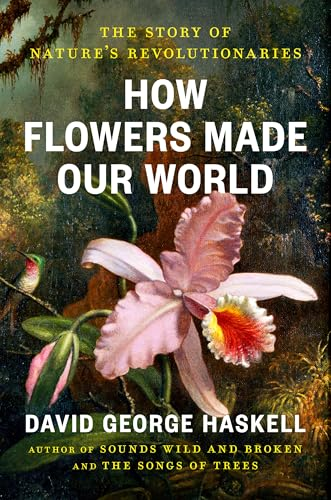
I love flowers and natural history, so this book caught my eye with little difficulty. Despite all of the natural history documentaries I watch, I still have difficulty believing that flowering plants have only existed on Earth for 130 million years. (“Only,” she says. Let’s remember that the planet is over 4 billion years old.) Sharks have existed on Earth longer than flowers.
Haskell discusses the ecological and cultural value of several species of flowering plants, such as the magnolia—fossils of which have been found to be 95 million years old, showing that the plant has changed very little in the ensuing millennia—the weird and wonderous orchid; grass, a plant that after thousands of years is still a main source of food for humans; and tea, a plant that sparked wars. Haskell discusses the impact pollution has had on seagrass and the creatures that rely on it. He investigates each plant’s origins, its evolution, and its value both culturally and commercially. This was a lengthy book, but I found all of it both informative and entertaining. The end of the book even includes a supplement: “Invitations to Play with Flowers,” a whimsical ending to a book that blends science with a genuine love of plants for their own sake. I know several fellow plant-lovers that will appreciate this book.
***
Against Breaking: On the Power of Poetry by Ada Limon
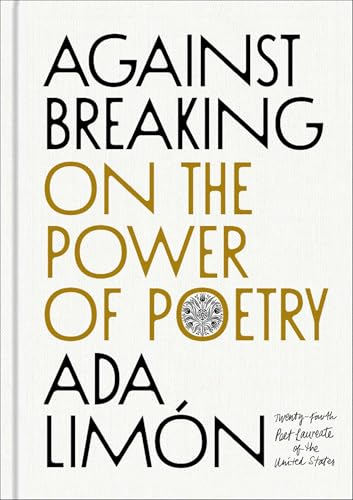
Ada Limon, the 24th Poet Laureate of the United States, gave this closing lecture on April 17, 2025, before an audience at the Library of Congress. In this lecture, she recounts the unexpected virtual call in which she received the invitation to serve (and her bemused acceptance of) and the work she did while holding the title. While serving as the Poet Laureate, Limon made significant contributions to the expansion of poetry to the reading public in the form of her project “You Are Here.”
This small book is an absolute treasure. Whether you are a writer of poetry or a reader in love with the genre, Limon’s reflections offer a very moving, personal view of this art of the soul. In the opening lines, she tells her audience that when she first sits down to write, she asks herself “Do I want to break something, or do I want to try to mend something? Or simply try to carve out a small place to breathe. I want, and have always wanted, only to make something true.”
Further on she says, “When clarity is hard to come by, when language has morphed into a tool for confusion, I put my faith in poetry. Then, if I’m lucky, if I’m quiet enough, lines of poems I love start to move.” I understand this on a personal level. Often when I am writing, I realize I am trying too hard, trying to force the words, the lines, the phrases to come. Poetry cannot be forced. One must sit quietly and wait, much as when one is in the woods, listening to birdsong, waiting for a bird to land before you.
As she expressed in her public poetry installations in national parks, Limon says “[…] poetry lives in all communities. …[it is] a way of testing for humanity, individuality. …Poetry does the work of opening us up to our feelings…”
Limon gave this lecture in 2025, and her words are still painfully relevant today: “Perhaps, in dire and dangerous times like these, all poetry can do is remind us where courage comes from.” In a world where schools are being levelled by bomb strikes and families torn apart by militant “police;” where the safety and lives of more and more people are being threatened because someone doesn’t like who they are, courage is a precious, fragile thing found deep within. “When the world says things are impossible,” Limon states, “poetry says, is that true?”
With everything happening in the world today, it is understandable to think that poetry is frivolous, a style of writing that isn’t relevant to politics or business or power. Limon disagrees. “Why does poetry matter, you ask? Poets respond, Because we’re all going to die.”
And finally, “If you need to be reminded of what makes us human, tender, brave, flawed, and worthy of love, then you need poetry.”
***
Visitations by Julia Alvarez
Alvarez’s work spans decades and crosses genres. I have read her novels (brilliant), but her poetry is my favorite of her writing. In “Visitations,” Alvarez writes of the upheaval of her childhood, from reciting poetry for her mother’s friends in starched party dresses to struggling with her cultural identity as she tries to adapt to life as an American after living in the Dominican Republic for ten years.
She considers the seasons and their reflection against our lives, seasons that didn’t exist in her childhood and now define the cycles of her life. She speaks of her sisters: the four daughters of the family, and the power to be found in groups of women and mourns the loss of the sister that couldn’t fight any longer.
Julia Alvarez’s poetry is a celebration of who she is and where she comes from. She writes of beauty, loss, danger, and home as a place of peace and belonging. “Visitations” is a book for everyone that has ever endeavored to find their place in the world they inhabit.
***
Lady No by Kim Hyesoon
I have never read Kim Hyesoon’s work before. Her writing brings to mind the style of Margaret Atwood and Alice Notley. Kim’s writing is fierce and direct. It forces you to pause and reread to fully understand the depth of her words. She meditates on poetry as a guide: “[…] For months, I’ve had a poem taped to the bathroom door and have been reading it. / Every time I read it, the poem points toward another direction, toward another world.”
Kim calls out the commercialization of literature and how it is being twisted to be “useful;” how people are forgetting that literature exists for the soul, not for the sake of digital medial producers. Reflecting on this, Kim says poetry “might as well be classified as an Intangible Cultural Heritage.” Should poetry disappear, what remains will be “legends of poets and rumors in the wind about poetry…solipsistic essays, bellows, and modicums of behavior…sentimentalism and poses…” She reminds readers that “Poetry goes beyond a ‘name,’ beyond identity…”
Kim uses poetry to call attention to the ills of society. “Document Human” is all too relevant in the United States at present; “By the River Ouse” recalls Virginia Woolf’s battle with mental illness, and “Princesses in Formaldehyde” asks a question women the world over are forced to ask again and again: “Why do they hate women…?”
Kim Hyesoon’s work leaves its mark in the mind. You will find yourself coming back to it, reconsidering what you thought she meant, wondering what it means to you, what it means to be you. Kim’s work makes you consider what it means to be human.


Leave a Reply