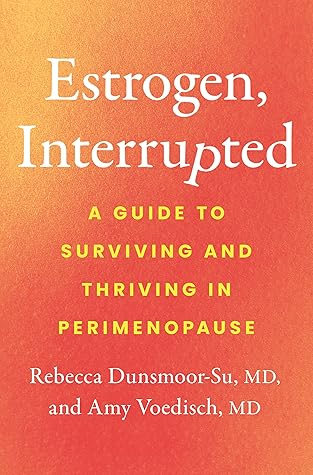
Thank you to NetGalley and Flatiron Books for the ARC of Drs. Dunsmoor-Su and Voedisch’s book Estrogen, Interrupted.
Let me begin this review by stating that if you do not like that I speak about “people that menstruate” and “people with female reproductive systems” instead of “women,” feel free to never read my blog again. Not everyone that experiences menstruation, perimenopause, and menopause are women. That being said, all thoughts in this review are my own and not influenced by anything other than common decency.
This was another add-in to my Summer Reading List; I made the list after requesting it from NetGalley, but before they sent it. I will never say no to more books, especially one like this. I think everyone should read this book: people approaching perimenopause, people experiencing it (that would be me), the men in their lives, men that know people that menstruate… This book is so informative. I had some idea of what to expect when I reached my late 40s, but I was not aware of how severely debilitating perimenopausal symptoms could be. I am very thankful that my current symptoms are mild, especially when reading of the severity of health issues the patients that Dr. Dunsmoor-Su and Dr. Voedisch have treated. Currently brain fog is the biggest issue I’m struggling with, and I don’t know if I can actually blame that on perimenopause or my own natural-born flakiness.
On a more serious note, Drs. Dunsmoor-Su and Voedisch have taken the time to thoroughly explain every stage of female biology and reproductive health and how the whole body, not just the reproductive system, reacts to it. They discuss the brain’s function in the production of hormones, explain what causes hormones to fluctuate and the physiological symptoms this presents, and offer advice on reliable treatments as opposed to all of the ones that are thrown around online, most of which don’t work, and many of which are actually harmful. Some treatments are basic, every-doctor-will-tell-you-this advice, such as maintaining a regular sleep schedule and maintaining a healthy diet and getting plenty of exercise. And by exercise, they just mean movement. If all you are up to doing is a slow walk down the street and back, perfect. Some people have much more severe symptoms and may need hormone management therapy during perimenopause. Drs. Dunsmoor-Su and Voedisch discuss this treatment in detail, explaining the types of hormones used and what they do.
This book holds a wealth of information that all people with female reproductive systems should know. Perimenopause can last a long time (up to ten years!) and people experiencing it need to know that they do not have to sit back and suffer. Yes, it is a part of life, but it doesn’t have to be a nightmare.
Estrogen, Interrupted will be published on June 16, 2026.
 This is the Mask: A Book Blog
Leave a comment