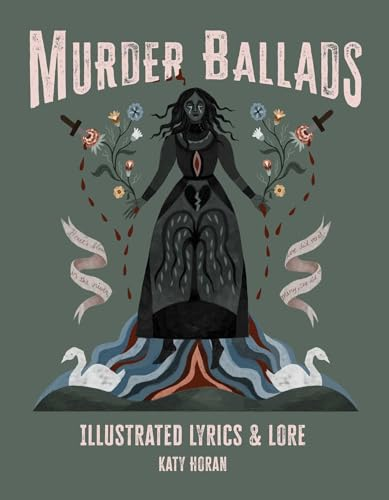
Murder Ballads by Katy Horan is a treat for fans of Dark Folklore and Gothic themes (that’s a gruesome way to begin a review, isn’t it?). I was already familiar with “The Death of Queen Jane” and “The Twa Swans” thanks to Loreena McKennitt. Horan included a list of recordings, so readers can immerse themselves fully into the eerie beauty of these lyrics. Horan includes some backstory to each of the selected ballads; this led me down a rabbit hole of reading the expanded stories behind these ballads. Katy Horan doesn’t just present her readers with a collection of songs, but a unique volume of true crime as well. Apart from the two songs McKennitt produced, I would say my favorite is the rendition of “Where the Wild Roses Grow” performed by Nick Cave and Kylie Minogue. I definitely recommend this darkly beautiful collection to anyone who loves folklore, poetry, and the Gothic and Romantic literature of the nineteenth century. You will absolutely love it. Be warned, though, you will spend hours looking up music videos.
My sister and I are proud Muffin Wallopers and set aside time every Sunday to engage in pursuits associated with this title. “What is a Muffin Walloper?” you ask. Allow me to enlighten you.
Per WordGenius.com, “A “muffin-walloper” is an unmarried woman who gathers with friends to gossip. In the Victorian era, these conversations often happened over tea and cakes — hence the muffin part of the phrase.” Now, my sister and I are both happily married women. And we don’t actually gossip during these Sunday afternoon sessions. We brew ourselves cups of tea, make nice little snacks, and sit down with our phones, pens, notebooks, and a highlighter or two and discuss our current “Sister Read,” a book we have chosen to read together. We tried to host an online book group and invited other Muffin Wallopers to join us, but no one participated, so we decided to go solo (duo?). The phones are a necessity because I live in Western Massachusetts, and she lives in Coastal Maine.
Since summer, we have been reading Philippa Gregory’s Normal Women:Nine Hundred Years of Making History. This book has been both enlightening and absolutely infuriating. Spoiler alert: absolutely nothing has changed regarding women’s rights, roles, safety, or status in nine hundred friggin years. We are holding our final discussion for this book on Monday 12/9 after we wrap up the Afterword (postponed due to my daughter’s baby shower on 12/8…yay baby! My youngest grandson is due in January, and I cannot wait to meet him. In the meantime, I shall continue to spoil his brother and sister.)
We have agreed to take the rest of December off to work on our December TBRs. I shared mine in a previous post. (see the link here: https://nicolekperkins.com/2024/12/01/december-tbr/ if you are interested in taking a look) By an amusing consequence, we both decided to read The Old Magic of Christmas by Linda Raedisch. I expect we will have a phone call to discuss it once we have finished it. I’m currently reading it; I have no idea what Sister is reading at present. Besides Normal Women, that is.
January 1st will see us begin our next Sister Read, The Woman They Could Not Silence: One Woman, Her Incredible Fight for Freedom, and the Men Who Tried to Make Her Disappear by Kate Moore. (Henceforth I shall refer to this book as TWTCNS because like all kickass titles it’s very long.) I have read Kate Moore’s incredible and horrifying book The Radium Girls: The Dark Story of America’s Shining Women. My sister has not, and I did suggest this as our next book, but we both own a copy of TWTCNS because I forgot I had a Kindle copy and bought it in paperback. Guess who got a free paperback copy of TWTCNS?
The Woman They Could Not Silence tells the story of Elizabeth Packard, jailed in an insane asylum by her husband for being inconvenient. (Minor spoiler, Elizabeth Packard was not mentally ill.) From Goodreads:
“1860: As the clash between the states rolls slowly to a boil, Elizabeth Packard, housewife and mother of six, is facing her own battle. The enemy sits across the table and sleeps in the next room. Her husband of twenty-one years is plotting against her because he feels increasingly threatened – by Elizabeth’s intellect, independence, and unwillingness to stifle her own thoughts. So Theophilus makes a plan to put his wife back in her place. One summer morning, he has her committed to an insane asylum.
The horrific conditions inside the Illinois State Hospital in Jacksonville, Illinois, are overseen by Dr. Andrew McFarland, a man who will prove to be even more dangerous to Elizabeth than her traitorous husband. But most disturbing is that Elizabeth is not the only sane woman confined to the institution. There are many rational women on her ward who tell the same story: they’ve been committed not because they need medical treatment, but to keep them in line – conveniently labeled “crazy” so their voices are ignored.
No one is willing to fight for their freedom and, disenfranchised both by gender and the stigma of their supposed madness, they cannot possibly fight for themselves. But Elizabeth is about to discover that the merit of losing everything is that you then have nothing to lose.”
For the last few months my husband and brother-in-law have been watching Sunday afternoon football to the not-so-muffled sounds of their wives’ raging over topics discussed by Philippa Gregory in her book. I think by the time Sister and I are done reading TWTCNS our long-suffering husbands are going to hope we read something much lighter in topic, like True Crime.
I will post a review on Normal Women after Sister and I have our final discussion so I can share her thoughts on the books as well. For those of you who may have already looked it up, it is a monster of a book, covering a lot of material, some of it very hard to read.
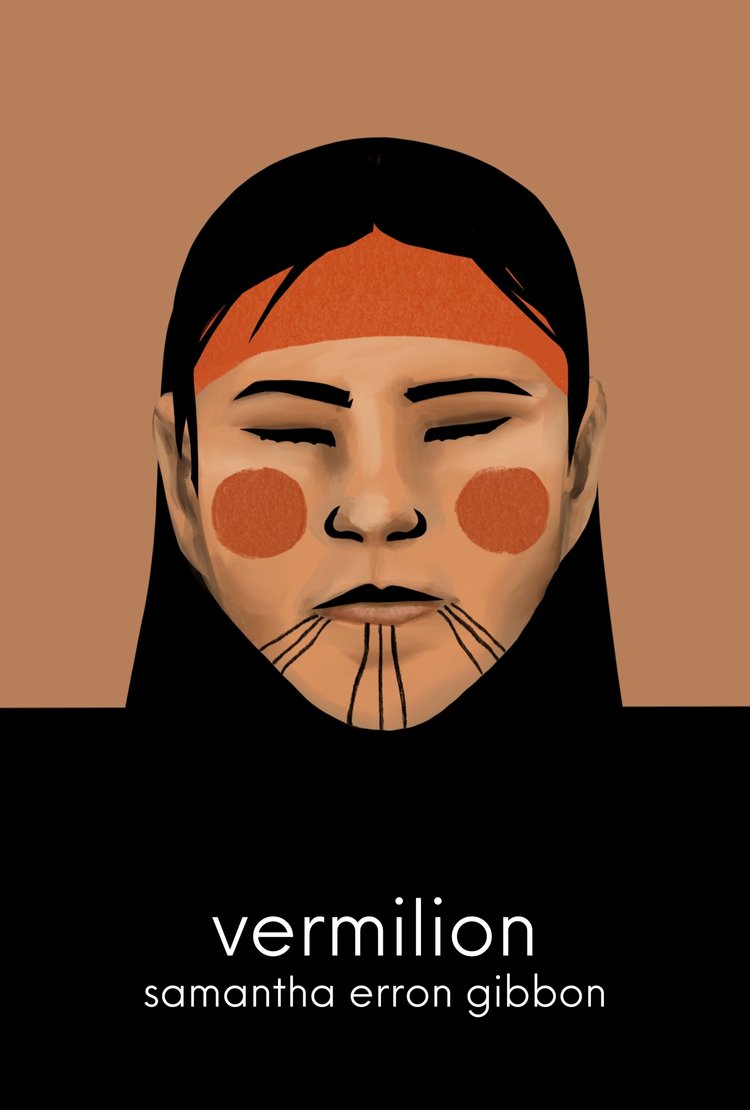
I feel as though I have been given a precious gift with this ARC of Vermilion by Samantha Erron Gibbon (kindly gifted by Querencia Press). I have an enormous amount of respect for the culture and heritage of the First People of the Americas, and I am well aware that others suffered as my ancestors settled and prospered. Too many people became disconnected from their culture and traditions; so much knowledge and lore was lost. The keepers of this knowledge are to be respected. The oral history and legends of the First People as every bit as valuable as the ruins of every ancient European temple. In this exquisite book, Gibbon has allowed me to see her sacred history. While I cannot read all of her words, I understand what she says. Her book is a prayer to life, to the Mother of us all. It is a reaching out, a sharing of the wonders of this world, not meant for one person’s possession but to be granted to all. Samantha Erron Gibbon’s beautiful book is an offering to humankind.


 This is the Mask