Let me begin by expressing my sincere thanks to NetGalley and all of the Publishers for the opportunity to read all of these books. I am truly grateful and love writing these reviews. I’m just rather lax in uploading them promptly. (Actually, that’s not entirely true; they are posted on NetGalley and Goodreads relatively quickly. Here, not so much.) There are a few here (!), so let’s dive in!
Same by Hannah Rosenberg (2 stars)
“Same” by Hannah Rosenberg is a celebration of simplicity. Her poem “Me as a Woman, Me as a Girl” closes with “I’ve been waiting my whole life to take car of someone like you,” emphasizing that may of us become the adults we needed in our lives when we were children. She speaks of her daughter in “Generational Drama”: “I can teach her hat she is a light,/ and that she doesn’t have to dim herself/ for anyone.”
“Old and Wild Things” reminds us that “with all of the things that make us wild and old,/ we are a thing of beauty, too.” Rosenberg tells us that we are our own heroes: “Suppose you thought, from that very first day,/ I’ve been the hero of my own story. I’ve been the/ one who’s saved my own life.”
A line from “I don’t know much about human biology” has stayed with me, and I feel that many people can appreciate this sentiment: “I don’t know much about human biology, but it is/ kind of comforting to know that inside, we’re all a mess.” Fitting words for this day and age, I think.
The World After Rain by Canisia Lubrin (2 stars)
“The World After Rain” is Canisia Lubrin’s elegy to her mother. Her poems give us the sensation of how it feels to be floundering, drowning in emotion when faced with such a loss. There is anger as well as sorrow in the poems, hurt and regret, such emotions as one feels following any kind of loss. When the floodgates of sorrow open, these kinds of poems are born.
A Bright and Borrowed Light by Courtney Kampa (2 stars)
Unfortunately, this collection did not really speak to me, and I cannot say why precisely. Some lines struck me as particularly noteworthy, such as “Beauty is what the soul has made suffice;” and “How little/ love is. How worth everything.” Brilliant, really. “How to Make Love in a Poem” is probably my favorite in the collection, less for the subject than for the word play. The poem “It’s You I Like” is a painful reminder of all that is wrong in a world where children have to practice safety drills in school. These poems are well-written, and I can recommend this collection, but it really wasn’t for me.
How About Now by Kate Baer (4 stars)
I am a decided Kate Baer fan. I own two of her other books and was gleefully excited to receive this ARC from NetGalley and Harper Collins (Thank you!). I loved this collection, as I expected I would. “Marriage Poem” is a close reflection of my own marriage, except my husband and I have 5 children. “Alice at Sixteen” is a blackout poem taken from Alice in Wonderland, and it is superb. Baer reflects on knowing oneself: “How simple it must be to wake up knowing/ who you are, what you want.” “One Day” is about the beautiful and very painful process of watching your children grow up. Benjamin Franklin once said, “Nothing is sure but death and taxes,” but I think Kate Baer said it better: “We can’t avoid it: mothers, death, and poetry.”
The Book of Alice by Diamond Forde (2 stars)
“The Book of Alice” by Diamond Forde is a collection of poems describing the shock of leaving home and heritage behind; the pain and paths of first love; and questioning the world as people clamber over the roadblocks of life. These poems recall the horrors and atrocities of slavery and its legacy in present-day lives. It is a history that needs to be remembered, and its victims and their descendants honored.
In Storm & Stillwater by Ifunanya Georgia Ezeano (2 stars)
I received this as an ARC from both NetGalley and Querencia Press! This collection fell rather flat for me. There were some beautifully written lines that I copied into my commonplace book; my favorite being “You remember you are not a soldier. You are/ just a wild child life is taming,” something I feel we should remember; we all need to be kinder to ourselves, and in doing so, we can be kinder to others. Unfortunately, overall, this book felt like a standard “angry poet finds catharsis in writing” collection. I didn’t dislike it, but I would like to see more originality.
Patchwork by Catarine Hancock (3 stars)
Catarine Hancock’s book “Patchwork” is a collection of heartfelt, hopeful poems. In them she reflects on relationships that blossom, bloom, and fade, showing both her vulnerability and her strength. She shares despair and hope, and reveals her journey back to her own self after sharing it with another person, the wrong person, for so long. Hancock’s poems are beautiful and moving. This is a lovely collection.
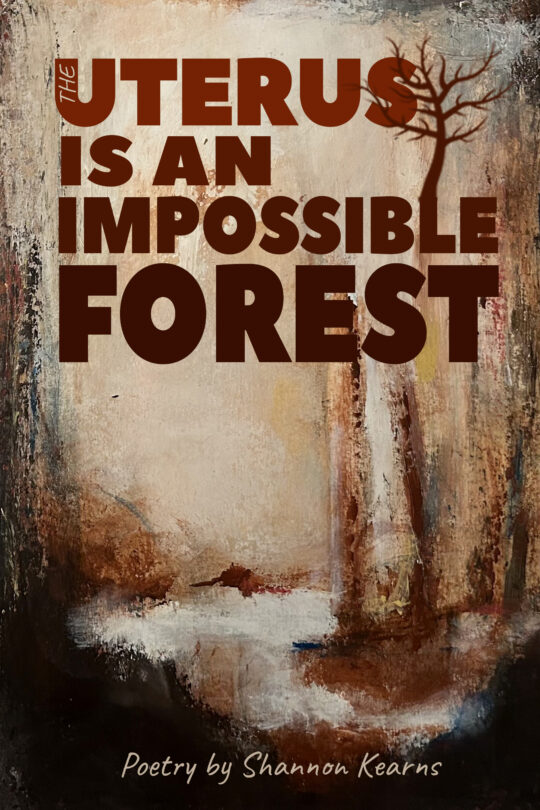
The Uterus is an Impossible Forest by Shannon Kearns (4 stars)
I loved Shannon Kearns’ “The Uterus is an Impossible Forest.” I feel that Kearns’ writing holds the same taut imagery as Sylvia Plath’s work as she writes about women’s experiences with Life. Kearns’ poems often have abstract formats; “Mad Woman” is brilliantly presented in a pattern of crossed out words, not exactly a blackout poem, but something more unique. The poem “Yellow” is reflective of Charlotte Perkins Gilman’s classic, and fits the aesthetic of Monica Robinson’s incredible “Peeling the Yellow Wallpaper.” “Alchemical Reaction” tells of the days (and nights) of early motherhood when your baby is a fragile, almost ephemeral treasure; “Hair” reminds me of combing my own daughter’s hair when she was a little girl with wheat-colored waves falling to her waist. Now she is a married mother of three. I copied “My Body is a Church” into my commonplace book in it’s entirety: “oh/ how I want/ to say yes/ not to a god/ or the many gods I have/ placed/ on my altar (god of shame, god of good, god of nothing)/ how I want to say/ yes/ to a garden/ of spindly yearning/ that desiccate/ the architecture/ of that good/ and that god/ and grow like ivy cracking marrow—”
Kearns’ words reflect the experiences of so many women: “I have been taught/ my yes is a tamed wind/ don’t let it topple./ I have given es over/ and over until all that’s left/ is a hollow egg,/ brittle and bearing.”
I cannot recommend this book enough. I received the ARC as an e-book; I will be purchasing this in print form to add to my collection. This is an outstanding collection. Read this.
The Garbage Poems by Anna Swanson (4 stars)
This collection should be read with Elisabeth Tova Bailey’s “The Sound of a Wild Snail Eating.” Different genres and contexts, but both are outstanding works of art created in the aftermath of chronic illness. Following a debilitating head injury that cost Swanson her entire way of life, she came up with the idea of creating poetry crafted from the rubbish she found lying around. In a manner after “found poems,” she created a narrative reflecting her hopes amid illness, willing herself back to health. I love this concept. I write found poems, but I take them from other poems, or lines from books. I would never have thought to gather up just stuff, and craft a poem of words collected off cans and bottles and packaging. Swanson is brilliant in this. The creative concept aside, Swanson’s poems are fantastic. I understand the print edition will also have illustrations by April White; I intend to look this up so I can experience the full effect of Swanson’s vision.
Lullabies for the Insomniacs by Ella Foutz (3 stars)
As someone with Major Depressive Disorder, I can sympathize with Ella Grace Foutz’s struggle with Bipolar Disorder. I feel very fortunate that I had a doctor who listened to my symptoms and didn’t tell me “it was all in my head,” (which is ironic considering it is in fact associated with the brain). I feel so grateful that I have never struggled as much as others have; Foutz’s story is harsh, raw, nerve endings on fire as she fights to quiet the noise, to find peace, to just sleep. As she illustrates in “Unicorn,” a problem with mental illness is that you don’t look sick, and if you don’t look sick, you must not be sick. Meanwhile your brain is zooming through the galaxy collecting trinkets like a crow as otherworldly songs sing a cacophony in your skull.
She lays out the harsh reality in “Heritage”: “Being sick is not a superpower./ Dying on the inside is not some noble battle that must be fought/ for the greater good of the art. […] Madness is not a contingency of greatness/ Insanity is not a prerequisite for genius.”
We are not far away from the days when someone with a mental illness was “insane” and shut away from the world in asylums. We are still living in a time where mental illness is considered a joke, fake, or it makes someone less than. Those of us that live with mental illness don’t choose this, and if we had a choice I can guarantee most of us would choose otherwise. Consider this: “I am not my mind”–a very useful mantra. /Except,/ Um./ of course I am.” While waiting for her diagnosis, Foutz struggled to separate herself from her illness. Eventually she comes to understand: her illness is part of her, but it does not define her.
Coffee Stains On My Books by Stefania Lucchetti (3 stars)
In “Coffee Stains On My Books,” Stefania Lucchetti weaves Greek mythology with episodes of modern life. I found some of Lucchetti’s pieces to be very moving; “Teenager” made me misty-eyed thinking about my own sixteen year old. “Words” describes what draws writers to their craft, the allure and the need to capture the words floating around us each day. “Art, faith, and hope” reads like a prayer itself: “There is nothing more powerful than hope. / Hope expressed as art, / hope expressed as faith, / hope expressed as magic / and art and faith and hope expressed as prayer. / This is the soul of magic.” Lucchetti has given her readers a lovely collection of modern-day mythology, reflective of any person’s thoughts, loves, and life.
Bramble by Susan Stewart (4 stars)
“Bramble” by Susan Stewart is a collection of poetry that walks readers through life events viewed as an allegorical briar thicket. Who in their life has not felt like they are fighting their way through briars at least once, pierced and scratched by thorns made up of events we can’t control? “Ps. 102” is a beautiful vignette of a moment, simply written, lovely in its simplicity. “Waterfall near Corchiano” describes a painting in exquisite detail, while “The Horseshoe Crab” is both melodious and melancholy. “Minor Musics” reads like an enchantment: “A bobbin, a needle, a thimble, and chalk. / If it’s too far to run, it’s too close to walk. / A needle, a thimble, chalk, and a bobbin. / The cheer of a robin, now what was that?” What kind of spell will this chant cast?
In “Lucretius,” Stewart reminds us that there is hope despite our tribulations: “…One thing will clarify another, / and dark night will not rob you of / your way…” I copied so much of this book into my commonplace book, I can’t really do it justice in my review. I found this book truly beautiful and thought-provoking. This is one I will turn to again and again.
Ajar by Margo Lapierre (4 stars)
Margo Lapierre’s “Ajar” is a view of life reflected through a prism. One poem brought Charlotte Perkins Gilman’s “The Yellow Wallpaper” to mind: “Psychosis is a living metaphor. / Late at night, the walls emanate radio music. / Patterns erupt like nerves.” It is only one small step from here to tearing the wallpaper off the free the music locked within. “Amethysts & Satellites” is the scattered thoughts of a mind too busy to focus on one point yet returns to that thought again and again despite the noise within. Lapierre paints words beautifully here: “…cranes erecting towers mine / amethysts from the cloud cover. / Rain. Let us have it.” And later, “Advice splinters into puddles, / the sky sits in her rain, / bellowing orange.” In “Mental Kaleidoscope: Where There’s Wood There’s Fire” she tells us “a cut mind coils / like tongue around cavity”
Lapierre’s poems are sharp; they catch you and force you to bear witness to life with mental illness: its highs and lows, and the dazzling sense of being between them. Lapierre has given her readers an invitation to look into her world with all its fractures and flaws: “When my name was dropped on my head in spotted sun- / shine, I mistook real for unreal and I haunted me…Each time as a child I refused to play the Ouija board, / it was to make sure nothing haunted me but me.”
I thought this was an incredible book. I have been recommending this book to all of my reader friends, and I definitely want to read more of Lapierre’s work.
If you have stuck around long enough to get to the end of this post, thank you!! More reviews are forthcoming; I just finished Ursula K. Le Guin’s phenomenal essay collection “The Language of the Night,” I am currently reading “Lone Yellow Flower” by Erika Gill (thank you Querencia Press!), and “Pride and Pleasure: The Schuyler Sisters in an Age of Revolution” by Amanda Vaill (thank you NetGalley), and have a dozen more ARCs waiting. I also think I have missed some reviews here; I need to check my NetGalley dashboard *sigh*
Anyway, this is just to say that there are plenty more reviews coming! I will also try to remember to post about the books my sister and I have read in our two-girl book club (Muffin Wallopers unite!) Thank you for visiting and for reading my ramblings. Stay safe, stay happy, and be well!


 This is the Mask