My favorite month after October, National Poetry Month gives me an excuse to overindulge in all of the poetry! I read even more than I normally do, and I try to write at least a few new poems instead of editing the life out of existing ones. I also love to share poems any way I can. My coworkers often come in to find a poem slipped under their office doors, or taped to their mailboxes. My goal for this year is to share a poem a day here as well as surprising my unsuspecting coworkers with random poems. We’ll see how I do. In the meantime, let’s kick off this beautiful month of literary magic!
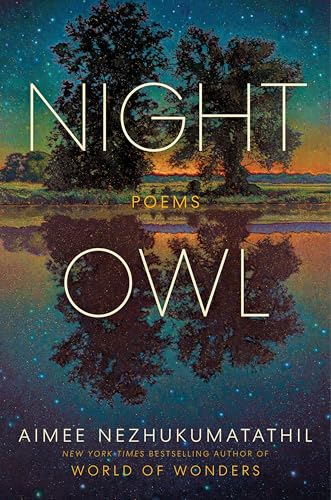
I would like to extend a sincere thank you to NetGalley and Ecco Books for the ARC of Aimee Nezhukumatathil’s gorgeous collection “Night Owl.” It is very appreciated!
This volume of poetry is a treasure. Aimee Nezhukumatathil is a gifted writer; I loved her book “World of Wonders.” This is her first volume of poetry I have read, and I intend to read all of the others.
Her poems are elegantly crafted. In these lines from “Nocturne for Dark Things,” she writes: “I do my finest listening in the dark/ My best friend has always been ink/ and she lets me talk so much at night./ One of the marvels of my life-/ an alphabet. A whole green and mossy/ world can be made and remade/ from just twenty-six dark curlicues.” These words define my own love of words and writing.
In “Pillow Talk Ars Poetica,” she says: “When twilight ends, I walk through a cloud of perfume […] What began was a glorious night not meant for sleep. When we first danced, I wrote a paragraph of leopard steps all over the tiled floor until I remembered I also held a roar. And then-I wrote a book.”
Nezhukumatathil writes imagery with an artist’s pen: “Once, we held our own universe in the morning rain;” and “If you don’t eat/ a nectarine outdoors while you squint/ in the sun, and a few drops of juice/ land on your shirt, can you really say/ it’s summer?” The poem titles themselves are enchanting, such as “When You Are Near, I Turn into a Baja Fairy Duster at Night,” and “Firefly Nocturne.”
Her poem “For Elephant Poachers: An Invective” is a moving plea to protect the giants of the earth, and “What If Medusa” demands justice for all women: “There are no published accounts of Medusa ever turning another woman into stone./ Not a single woman./ What if Medusa was someone who simply learned/ to fight back against those who would harm her?/ Who gets to call whom a monster?” Who indeed?
She writes of horrific incidents of racism she has experienced, justly pointing out that none of the episodes of racism and violence she has experienced were at the hands of people of color. All of her attackers have been white men. “So,” she says, “forgive me if I laugh at your fear and hatred of brown immigrants, or when you say immigrants are a danger to the fabric of our country.” Despite this, her love for her country, her parents’ adopted country, shows in her words: “In an olive grove, you can hate/ the fruit and still love its light.” The United States is a place of beauty, she seems to say, even if the people are ugly. And in “American Tenderness,” she says, “I was born from a snapdragon-from a burst of seeds knocked clean by a rabbit escaping a fox.” She is here, born in this country, and her thoughts and words burst forth to enrich the lives and minds of others.
I cannot praise this book enough. Nezhukumatathil’s writing touches the heart and opens the soul. I copied so much of this into my commonplace book so I can refer back to it because these poems breathe, they are alive and vibrant. Aimee Nezhukumatathil is a writer for the soul of humanity.
I received a review copy of this brilliant book from NetGalley and Scribner, and could not be more appreciative!
“…the pursuit of art…by artist or audience, is the pursuit of liberty.” -Ursula K. Le Guin
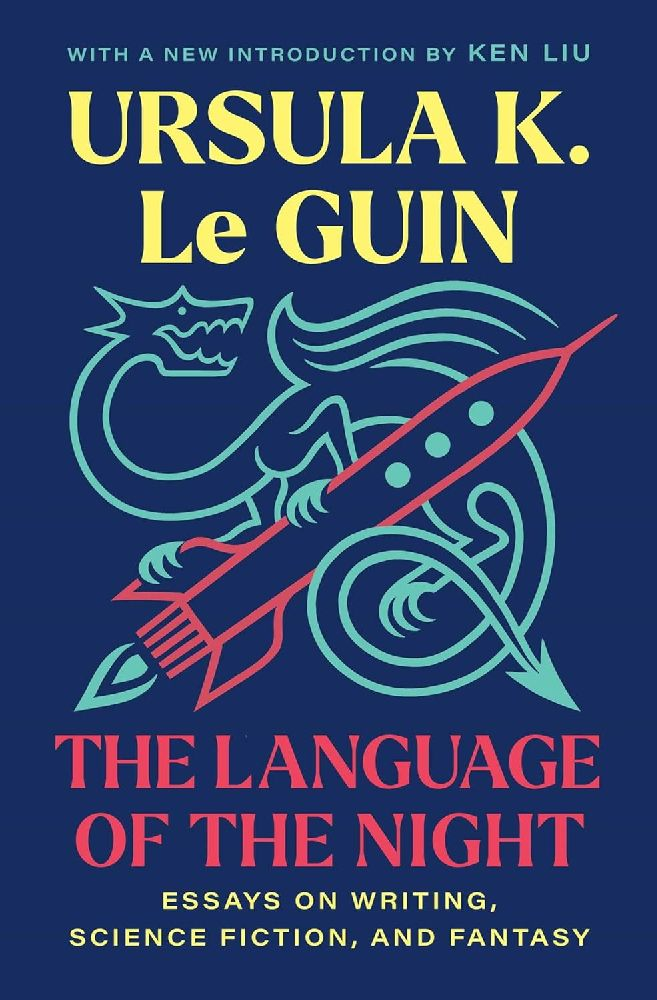
Ursula K Le Guin was a master storyteller. Her work has entertained and enthralled thousands of readers for six decades. I knew her primarily as a SciFi author; this collection of brilliant essays has introduced me to a new Ursula Le Guin, even more talented than I had imagined.
As the subtitle implies, Le Guin discusses her writing craft as well as her thoughts as a writer of SciFi and fantasy. She also discusses feminism, gender, politics, literary criticism, psychology, sociology, and so much more. I had requested this book as a writer looking to learn from one of the greats; I finished the book as a student of the Humanities. I was enthralled while reading her thoughts and took pages of notes. It has taken me too long to write this review; I honestly didn’t know where to begin.
Imaginative fiction is often considered to be frivolous, silly work that should be left behind as we become adults. (Try telling that to the hordes of Dark Fantasy and Romantasy fans of the world, I dare you.) Le Guin emphasizes the importance of imaginative fiction: “Those who refuse to listen to dragons are probably doomed to spend their lives acting out the nightmares of politicians. We like to think we all live in daylight, but half the world is always dark; and fantasy, like poetry, speaks the language of the night.” Allowing ourselves to experience the make-believe world enables us to manage the real world. If we can dream, we can do.
“The story […] is one of the basic tools invented by the human mind, for the purpose of gaining understanding. There have been great societies that did not use the wheel, but there have been no societies that did not tell stories.” Storytelling is the history of humankind, and its future. Without stories, we would not exist.
When discussing the value of faerie stories, Le Guin stresses “Children’s imaginative play is clearly a practicing at the acts and emotions of adulthood; a child who did not play would not become mature,” and “The use of imaginative fiction is to deepen your understanding of your world, and your fellow men, and your own feelings, and your destiny.” To read fiction is to imagine who we can be, Le Guin says.
Ursula Le Guin believed “…that maturity is not an outgrowing, but a growing up: that an adult is not a dead child, but a child who survived. I believe that all the best faculties of a mature human being exist in the child, and that if the faculties are encouraged in youth, they will act well and wisely in the adult, but if they are repressed and denied in the child they will stunt […] the adult personality.”
In discussing feminism, Le Guin said, “One of the great early socialists said that the status of women in a society is a pretty reliable index of the degree of civilization of that society.” I wonder what that person would think looking at today’s world. Le Guin doesn’t shy away from the faults within her own genre of choice: “Isn’t the “subjection of women” in SF merely a symptom of a whole which is authoritarian, power-worshipping, and intensely parochial?” In other words, art imitates life, and we need to do better. As Le Guin succinctly said, “I didn’t see how you could be a thinking woman and not be a feminist.”
“The Language of the Night” claims to be a book about writing, and it is. It is a book about writing as a means to authenticate life.
Let me begin by expressing my sincere thanks to NetGalley and all of the Publishers for the opportunity to read all of these books. I am truly grateful and love writing these reviews. I’m just rather lax in uploading them promptly. (Actually, that’s not entirely true; they are posted on NetGalley and Goodreads relatively quickly. Here, not so much.) There are a few here (!), so let’s dive in!
Same by Hannah Rosenberg (2 stars)
“Same” by Hannah Rosenberg is a celebration of simplicity. Her poem “Me as a Woman, Me as a Girl” closes with “I’ve been waiting my whole life to take car of someone like you,” emphasizing that may of us become the adults we needed in our lives when we were children. She speaks of her daughter in “Generational Drama”: “I can teach her hat she is a light,/ and that she doesn’t have to dim herself/ for anyone.”
“Old and Wild Things” reminds us that “with all of the things that make us wild and old,/ we are a thing of beauty, too.” Rosenberg tells us that we are our own heroes: “Suppose you thought, from that very first day,/ I’ve been the hero of my own story. I’ve been the/ one who’s saved my own life.”
A line from “I don’t know much about human biology” has stayed with me, and I feel that many people can appreciate this sentiment: “I don’t know much about human biology, but it is/ kind of comforting to know that inside, we’re all a mess.” Fitting words for this day and age, I think.
The World After Rain by Canisia Lubrin (2 stars)
“The World After Rain” is Canisia Lubrin’s elegy to her mother. Her poems give us the sensation of how it feels to be floundering, drowning in emotion when faced with such a loss. There is anger as well as sorrow in the poems, hurt and regret, such emotions as one feels following any kind of loss. When the floodgates of sorrow open, these kinds of poems are born.
A Bright and Borrowed Light by Courtney Kampa (2 stars)
Unfortunately, this collection did not really speak to me, and I cannot say why precisely. Some lines struck me as particularly noteworthy, such as “Beauty is what the soul has made suffice;” and “How little/ love is. How worth everything.” Brilliant, really. “How to Make Love in a Poem” is probably my favorite in the collection, less for the subject than for the word play. The poem “It’s You I Like” is a painful reminder of all that is wrong in a world where children have to practice safety drills in school. These poems are well-written, and I can recommend this collection, but it really wasn’t for me.
How About Now by Kate Baer (4 stars)
I am a decided Kate Baer fan. I own two of her other books and was gleefully excited to receive this ARC from NetGalley and Harper Collins (Thank you!). I loved this collection, as I expected I would. “Marriage Poem” is a close reflection of my own marriage, except my husband and I have 5 children. “Alice at Sixteen” is a blackout poem taken from Alice in Wonderland, and it is superb. Baer reflects on knowing oneself: “How simple it must be to wake up knowing/ who you are, what you want.” “One Day” is about the beautiful and very painful process of watching your children grow up. Benjamin Franklin once said, “Nothing is sure but death and taxes,” but I think Kate Baer said it better: “We can’t avoid it: mothers, death, and poetry.”
The Book of Alice by Diamond Forde (2 stars)
“The Book of Alice” by Diamond Forde is a collection of poems describing the shock of leaving home and heritage behind; the pain and paths of first love; and questioning the world as people clamber over the roadblocks of life. These poems recall the horrors and atrocities of slavery and its legacy in present-day lives. It is a history that needs to be remembered, and its victims and their descendants honored.
In Storm & Stillwater by Ifunanya Georgia Ezeano (2 stars)
I received this as an ARC from both NetGalley and Querencia Press! This collection fell rather flat for me. There were some beautifully written lines that I copied into my commonplace book; my favorite being “You remember you are not a soldier. You are/ just a wild child life is taming,” something I feel we should remember; we all need to be kinder to ourselves, and in doing so, we can be kinder to others. Unfortunately, overall, this book felt like a standard “angry poet finds catharsis in writing” collection. I didn’t dislike it, but I would like to see more originality.
Patchwork by Catarine Hancock (3 stars)
Catarine Hancock’s book “Patchwork” is a collection of heartfelt, hopeful poems. In them she reflects on relationships that blossom, bloom, and fade, showing both her vulnerability and her strength. She shares despair and hope, and reveals her journey back to her own self after sharing it with another person, the wrong person, for so long. Hancock’s poems are beautiful and moving. This is a lovely collection.
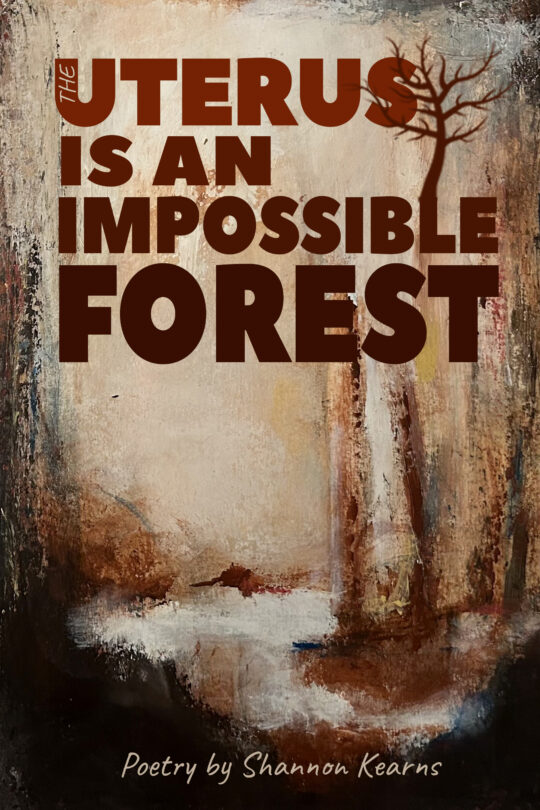
The Uterus is an Impossible Forest by Shannon Kearns (4 stars)
I loved Shannon Kearns’ “The Uterus is an Impossible Forest.” I feel that Kearns’ writing holds the same taut imagery as Sylvia Plath’s work as she writes about women’s experiences with Life. Kearns’ poems often have abstract formats; “Mad Woman” is brilliantly presented in a pattern of crossed out words, not exactly a blackout poem, but something more unique. The poem “Yellow” is reflective of Charlotte Perkins Gilman’s classic, and fits the aesthetic of Monica Robinson’s incredible “Peeling the Yellow Wallpaper.” “Alchemical Reaction” tells of the days (and nights) of early motherhood when your baby is a fragile, almost ephemeral treasure; “Hair” reminds me of combing my own daughter’s hair when she was a little girl with wheat-colored waves falling to her waist. Now she is a married mother of three. I copied “My Body is a Church” into my commonplace book in it’s entirety: “oh/ how I want/ to say yes/ not to a god/ or the many gods I have/ placed/ on my altar (god of shame, god of good, god of nothing)/ how I want to say/ yes/ to a garden/ of spindly yearning/ that desiccate/ the architecture/ of that good/ and that god/ and grow like ivy cracking marrow—”
Kearns’ words reflect the experiences of so many women: “I have been taught/ my yes is a tamed wind/ don’t let it topple./ I have given es over/ and over until all that’s left/ is a hollow egg,/ brittle and bearing.”
I cannot recommend this book enough. I received the ARC as an e-book; I will be purchasing this in print form to add to my collection. This is an outstanding collection. Read this.
The Garbage Poems by Anna Swanson (4 stars)
This collection should be read with Elisabeth Tova Bailey’s “The Sound of a Wild Snail Eating.” Different genres and contexts, but both are outstanding works of art created in the aftermath of chronic illness. Following a debilitating head injury that cost Swanson her entire way of life, she came up with the idea of creating poetry crafted from the rubbish she found lying around. In a manner after “found poems,” she created a narrative reflecting her hopes amid illness, willing herself back to health. I love this concept. I write found poems, but I take them from other poems, or lines from books. I would never have thought to gather up just stuff, and craft a poem of words collected off cans and bottles and packaging. Swanson is brilliant in this. The creative concept aside, Swanson’s poems are fantastic. I understand the print edition will also have illustrations by April White; I intend to look this up so I can experience the full effect of Swanson’s vision.
Lullabies for the Insomniacs by Ella Foutz (3 stars)
As someone with Major Depressive Disorder, I can sympathize with Ella Grace Foutz’s struggle with Bipolar Disorder. I feel very fortunate that I had a doctor who listened to my symptoms and didn’t tell me “it was all in my head,” (which is ironic considering it is in fact associated with the brain). I feel so grateful that I have never struggled as much as others have; Foutz’s story is harsh, raw, nerve endings on fire as she fights to quiet the noise, to find peace, to just sleep. As she illustrates in “Unicorn,” a problem with mental illness is that you don’t look sick, and if you don’t look sick, you must not be sick. Meanwhile your brain is zooming through the galaxy collecting trinkets like a crow as otherworldly songs sing a cacophony in your skull. She lays out the harsh reality in “Heritage”: “Being sick is not a superpower./ Dying on the inside is not some noble battle that must be fought/ for the greater good of the art. […] Madness is not a contingency of greatness/ Insanity is not a prerequisite for genius.” We are not far away from the days when someone with a mental illness was “insane” and shut away from the world in asylums. We are still living in a time where mental illness is considered a joke, fake, or it makes someone less than. Those of us that live with mental illness don’t choose this, and if we had a choice I can guarantee most of us would choose otherwise. Consider this: “I am not my mind”–a very useful mantra. /Except,/ Um./ of course I am.” While waiting for her diagnosis, Foutz struggled to separate herself from her illness. Eventually she comes to understand: her illness is part of her, but it does not define her.
Coffee Stains On My Books by Stefania Lucchetti (3 stars)
In “Coffee Stains On My Books,” Stefania Lucchetti weaves Greek mythology with episodes of modern life. I found some of Lucchetti’s pieces to be very moving; “Teenager” made me misty-eyed thinking about my own sixteen year old. “Words” describes what draws writers to their craft, the allure and the need to capture the words floating around us each day. “Art, faith, and hope” reads like a prayer itself: “There is nothing more powerful than hope. / Hope expressed as art, / hope expressed as faith, / hope expressed as magic / and art and faith and hope expressed as prayer. / This is the soul of magic.” Lucchetti has given her readers a lovely collection of modern-day mythology, reflective of any person’s thoughts, loves, and life.
Bramble by Susan Stewart (4 stars)
“Bramble” by Susan Stewart is a collection of poetry that walks readers through life events viewed as an allegorical briar thicket. Who in their life has not felt like they are fighting their way through briars at least once, pierced and scratched by thorns made up of events we can’t control? “Ps. 102” is a beautiful vignette of a moment, simply written, lovely in its simplicity. “Waterfall near Corchiano” describes a painting in exquisite detail, while “The Horseshoe Crab” is both melodious and melancholy. “Minor Musics” reads like an enchantment: “A bobbin, a needle, a thimble, and chalk. / If it’s too far to run, it’s too close to walk. / A needle, a thimble, chalk, and a bobbin. / The cheer of a robin, now what was that?” What kind of spell will this chant cast?
In “Lucretius,” Stewart reminds us that there is hope despite our tribulations: “…One thing will clarify another, / and dark night will not rob you of / your way…” I copied so much of this book into my commonplace book, I can’t really do it justice in my review. I found this book truly beautiful and thought-provoking. This is one I will turn to again and again.
Ajar by Margo Lapierre (4 stars)
Margo Lapierre’s “Ajar” is a view of life reflected through a prism. One poem brought Charlotte Perkins Gilman’s “The Yellow Wallpaper” to mind: “Psychosis is a living metaphor. / Late at night, the walls emanate radio music. / Patterns erupt like nerves.” It is only one small step from here to tearing the wallpaper off the free the music locked within. “Amethysts & Satellites” is the scattered thoughts of a mind too busy to focus on one point yet returns to that thought again and again despite the noise within. Lapierre paints words beautifully here: “…cranes erecting towers mine / amethysts from the cloud cover. / Rain. Let us have it.” And later, “Advice splinters into puddles, / the sky sits in her rain, / bellowing orange.” In “Mental Kaleidoscope: Where There’s Wood There’s Fire” she tells us “a cut mind coils / like tongue around cavity”
Lapierre’s poems are sharp; they catch you and force you to bear witness to life with mental illness: its highs and lows, and the dazzling sense of being between them. Lapierre has given her readers an invitation to look into her world with all its fractures and flaws: “When my name was dropped on my head in spotted sun- / shine, I mistook real for unreal and I haunted me…Each time as a child I refused to play the Ouija board, / it was to make sure nothing haunted me but me.”
I thought this was an incredible book. I have been recommending this book to all of my reader friends, and I definitely want to read more of Lapierre’s work.
If you have stuck around long enough to get to the end of this post, thank you!! More reviews are forthcoming; I just finished Ursula K. Le Guin’s phenomenal essay collection “The Language of the Night,” I am currently reading “Lone Yellow Flower” by Erika Gill (thank you Querencia Press!), and “Pride and Pleasure: The Schuyler Sisters in an Age of Revolution” by Amanda Vaill (thank you NetGalley), and have a dozen more ARCs waiting. I also think I have missed some reviews here; I need to check my NetGalley dashboard *sigh*
Anyway, this is just to say that there are plenty more reviews coming! I will also try to remember to post about the books my sister and I have read in our two-girl book club (Muffin Wallopers unite!) Thank you for visiting and for reading my ramblings. Stay safe, stay happy, and be well!
I have gotten VERY behind on posting reviews, both on books for my Summer Reading List (spoiler, I didn’t get to them all) and NetGalley books. This post will focus on the books I have read and reviewed for NetGalley; I’ll do another one on the Summer Reading List (mostly poetry and nonfiction. Does anyone have any tips on making oneself settle down and focus on fiction? I just can’t seem to do it anymore!)
Queen of All Mayhem by Dane Hucklebridge: 3 stars: Other than her name, and that she was an outlaw, I knew nothing of Belle Starr going into this book. The “Wild West” isn’t a subject I have spent much time on, so really, other than the names of the outlaws that made headlines and therefore history, I’m pretty ignorant of this entire piece of American history. In Queen of All Mayhem, Dane Hucklebridge brings this era to life brilliantly. is writing is engaging, his storytelling concise, though there were a couple parts where there was a great deal of exposition that perhaps could have been condensed, but it was relevant to the society in which Belle Starr lived. Hucklebridge takes his readers on Belle’s journey from a well-educated, cultured only daughter to her exploits as a Confederate spy, her rise to the title of Bandit Queen, and into what should have been her days of retirement and ease but were instead abruptly ended by an anonymous killer. Between her adventures she was a wife and mother, who longed for both the thrill of the heist and to hold her children close. Sadly, she had to send her son away to live with family for many years, and her daughter was in and out of Belle’s homes as well as family and friends’. Belle Starr is presented to readers as a multifaceted woman: intelligent, resourceful, sometimes foolhardy, loyal, always brave. She is a woman of legend, but Hucklebridge introduces readers to the woman behind the myth.
Working the Roots by Amanda Bennett: 2 stars: I am disappointed to admit that I could not really get into this book. I do like Bennett’s writing style, and her words have impact as I feel they were meant to. Poetry is a personal journey, after all. I wonder if my lack of connection to this work may be generational: I feel that I am much older than Bennett, and while some experiences of womanhood are universal, others are wildly different. I do recommend Working the Roots as I believe what Amanda Bennett has to say is of value, and I am sure that other readers will not only fully appreciate her work but see themselves in her words.
My Oceans by Christina Rivera: 2 stars: I was very much looking forward to Christina Rivera’s essay collection My Oceans. I was wondering if it might be similar in tone to Diane Ackerman’s or Elisabeth Tova Bailey’s writing. Sadly, I was disappointed. While Rivera has a wealth of knowledge to share, and has lived and worked in some incredible locations, her concerns for the environment appear to border on obsessive and are almost off-putting. Our planet is threatened; this is a fact proven by scientists. Climate change is destroying habitats and ecosystems, some may be beyond repair. The state of the planet is something everyone should be concerned about, and I do feel that everyone should do their part to preserve as many of our natural resources as possible. Thus, I and my family try to produce as little permanent waste as possible. We recycle; we reuse as much as we can. We are not perfect, and there is probably more we can do. I do wonder what kind of world my great grandchildren will inherit. I do not, however, wake up with nightmares about the micro plastics that are in my drinking water. I buy my children and grandchildren plastic brick building sets and do not flagellate myself with guilt for months after the fact. Christina Rivera is a talented writer, and her prose is well-worded. However, her anxiety absolutely leaps off the pages and takes attention away from her message. I finished her book, but it was a struggle, and felt a palpable sense of relief when I finished it. I do recommend this book, but I advise readers to step away from it every so often not because of the subject matter (though Rivera does share some truly gut-wrenching heartache and I honestly felt for her), but to just take a breather from her stress.
Groceries by Nora Claire Miller: 1 star: I expected this book to be poems reflecting on one’s relationship to the items around us, perhaps an allegory of possessiveness or capitalism, based on the synopsis. Instead I am not sure what Miller is trying to convey. I read a great deal of poetry in all its forms, so abstract or found poetry is not unusual to me. This volume is too scattered, lines begin and end abruptly without any continuity; overall, it feels messy. I have said in other reviews that poetry is a personal art. I know Miller has a message she is attempting to convey, and in her own mind she was probably successful. Readers are left floundering and frustrated.
Anthropological Study by Lauren Miller: 1 star: This book earned a one star rating from me. Lauren Miller’s poems are raw and personal, which I greatly respect. It takes a large amount of courage to put oneself on the page so honestly. I found many of the poems too disjointed; they seem to suddenly veer away into a different direction and discuss thoughts unrelated to the initial idea that was presented. Some feel as though they end too abruptly, as though Miller’s idea just stopped. Overall, I found these poems too unfocused to be enjoyable.
Unwed & Unbothered by Emma Duval: 4 stars: I thought Emma Duval’s Unwed & Unbothered was an excellent book. It’s not very long, but this small book holds a wealth of information. Duval showcases dozens of women in brief biographies, highlighting their work and accomplishments. I read a great deal of women’s history, and while I was familiar with many of the notable women she featured in her book, there were many, many others I had never heard of before. Duval’s book led me down a rabbit hole of research, and my TBR list now has an extra page of biographies. I absolutely recommend this book for anyone interested in history and women’s studies; really, I feel that everyone should read it. Too often women’s accomplishments and contributions are brushed under the rug. Emma Duval brings these women to the forefront and reminds readers that women are not silent bystanders. I feel that girls especially should read this book so they can remember that there is nothing they can’t do if they put their minds to it. I will be buying a copy of this for my seven-year-old granddaughter; I want her to always remember that she is an unstoppable force.
Between Two Rivers by Moudhy Al-Rashid: 4 stars: Between Two Rivers by Moudhy Al-Rashid is an incredible journey through centuries of Mesopotamian history. Al-Rashid offers readers a look at the beginning of recorded history, focusing on the development of writing from pictographs to written words. From inventories to laws to literature, the ancient Sumerians and later Akkadians left their mark (literally) on history. Archaeologists today are still unearthing clay tablets and ceramic seals bearing inscriptions of everything from goods exchanged to classroom writing exercises for apprentice scribes to paeons to the gods. Ancient Mesopotamia is credited with being the cradle of civilization, often because writing was developed there. I disagree with this idea as there are plenty of civilizations from history that did not have a writing system (some still existing today). I feel the combination of writing and agriculture is a stronger argument, though still not definitive. What has been proven is that the ancient people of the Middle East were the first to leave written records of their lives, and Moudhy Al-Rashid does a wonderful job of presenting these developments to readers. This book is a must-read for people interested in ancient societies (or for word nerds like me!)
Charles Dickens’ Secret Love Child by Brian Ruck: 1 star (I’d give it zero if I could): I could not get into this book. I will admit that I am not a huge Dickens fan; A Christmas Carol and A Tale of Two Cities are the only works of his that I like. The man was a master of storytelling, however, as his legacy of work and numerous fans will attest. Because of this I have read a number of books about Dickens; it is impossible to recognize the contribution he made to literature even if you don’t like his work. Brian Ruck lost me as soon as he suggested that Ellen Ternan was Dickens’ illegitimate child. Renowned Dickens scholars have all agreed and supported their research with evidence that Ternan was in fact Charles Dickens’ mistress, and that they had a child together. Ellen Ternan may have denied the relationship later in life, but letters and diaries survive confirming their relationship. Ruck uses language taken from some of Dickens’ letters to support his theory that Dickens had an affair with Ellen Ternan’s mother Frances Jarman Ternan and that Ellen was the resulting child. If anything, I think those snippets might indicate that Dickens had an affair with Frances and then years later began a relationship with her daughter. I am not a Dickens scholar, and I have no way to back up this theory; I am just reinterpreting what Ruck has interpreted himself. As well, Brian Ruck admits at the start of his book that he is not a historian or Dickens scholar, and his “proof” is very flimsy. All in all, I found this to be a biased and not well-supported study of Charles Dickens.
This was a very long post, thank you for sticking around! Some of these titles have just been published, and a few are coming out this month. Let me know if you read any of these; I would like to know your thoughts!
As a writer and book lover, I was very excited to read Emily Hodgson Anderson’s “Shadow Work: Loneliness and the Literary Life.” While I thought this book was very good and definitely worth reading–especially for writers–I didn’t love it. Some sections failed to hold my interest; however, other sections had me pausing, considering, rereading, and highlighting. I read this as an e-book, and despite my somewhat flat rating, I will probably pick it up as a paperback because I feel that much of her commentary is very thought-provoking.
The teakettle’s whistling is the music of sunrise musings: when I was younger I wanted to collect the stars. I had a heart full of ghosts and strawberry daydreams; I was a small-town girl with big dreams: a carnival of stars would get me there, I wouldn’t disappear like a glacier waiting for summer, instead I would become a wildflower woman. The smell of autumn is locked behind my ribcage like a child longing to be free, bare feet on soft earth, cardigan falling off a shoulder, writing our names in the clouds to feel alive: I am Sea Nymph, you be Woodland Witch. Looking into a crystal ball I see I am weathered by lost faith and heartache— please don’t let me grow cold like this winter sky. From the moment we met I knew the path to heaven is paved with frozen tears and haiku.
If Halloween and National Poetry Month were in the same month, my utter happiness would be complete. Alas, I only get to celebrate my birthday during Poetry month. To kick off the Poetry Month celebrations, one of my own:
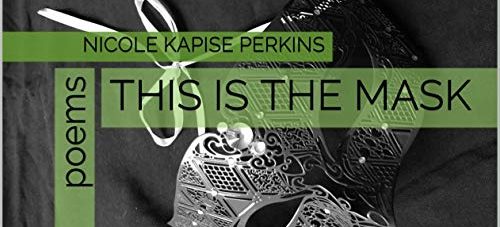
Love Doesn’t Rhyme By Nicole Kapise Perkins
“How are you, really?”
Just one of the many things you said with too many miles between us;
you were the sun of my sky,
and yet we never exchanged friendship bracelets,
never repressed words or scary truths.
My therapist asks me to talk about you,
how we kept moving without coming forward,
the silence between us,
the things you said at 2AM when you thought no one was listening
but I was.
Am I no one?
I often feel like my body is a graveyard,
darkness planted in salted earth,
Romans laughing as Mona rots—
can people change?
All of my ghosts say no;
they snicker and point at my inner child
as she walks on eggshells,
so fearful of dying summer.
Every new September
I wake up somewhere between now and then,
a half-remembered dream:
nectar on my tongue,
withering flowers and rotting fruit—
“I am not afraid,” she says, “I was born for this.”
Bathed in a golden aura, she burned in twin flames.
I wake in sunlight
with the realization that people I don’t know have a life as vivid as my own;
you, in your sleep,
used to recite Angel numbers.
We’re strangers again,
we shared a kiss that didn’t know it was the last one.
Your sun sign wasn’t compatible,
there were too many storms to weather
and you never mastered the art of finding beauty in toxicity.
I look around at the empty chairs spaced around the office like wallflowers at a dance.
“He smelled like a bonfire,” I say.
“He tasted like burned coffee. Love doesn’t rhyme. It doesn’t make any sense.”
In Permission, memoirist Elissa Altman asks “Who has the right to tell a family’s story? Who “owns” a family’s history? Do we need permission to tell our story?”
Altman says, “The writing of memoir is often fraught; our friends, colleagues, families, entire cultures turn writers into pariahs for what we create, for who we are, for how we dare take ownership of our own stories.” She also writes “Beyond time, space, and money to write, permission is the single biggest hurdle that the creative—new or accomplished—faces, and often over the most mundane of issues.”
I am not a memoirist; most of what I write is completely made up, influenced by true events perhaps, but very loosely so. I do not feel the desire to tell true stories, and I have never considered what my family’s reaction would be if I chose to do so. I expect there would be anger, as Altman experienced. I am sure I would be told I was wrong, lying, or accused of fabricating everything for attention. Others would relish the attention it would bring, being of the mindset that adverse attention is better than lack of attention. I do not think I would be disowned as Altman was; I think I would be allowed to remain so people could be disgusted with me.
Altman reminds her students, “No one owns the right to craft our story but us, but we must remember that the complex work of memoir demands that we also write with clarity, compassion, and ambiguity, which allows the reader to determine their own response to the story.”
Elissa Altman’s Permission is an outstanding presentation of memoir, writing, self-exploration, and how one experiences (and suffers from) a family’s reaction to a secret that needs to be told. I will be supplementing my e-copy with a print edition for both reference and the reminder that sometimes being true to oneself means standing alone in the face of disapproval and still telling my story.


 This is the Mask