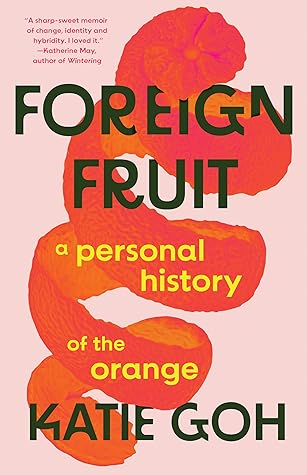
NetGalley Review: Foreign Fruit by Katie Goh

Foreign Fruit by Katie Goh is an outstanding book. I was expecting a microhistory about oranges, or citrus fruit as a whole; I was not expecting an incredibly well-researched social history about culture, society, belonging, searching for one’s place in the world, biases, acceptance, food cultivation, and environmentalism (among other topics). Goh’s book takes readers from Ireland and Malaysa to China, Italy via the Silk Road, France, Russia, and the United States. Readers witness the destructive oppression of Dutch and British colonialism, Communist tyrants, and violent racism. I had never heard of the Los Angeles Riot of 1871, in which nineteen Chinese immigrants were murdered, and no one was held accountable.

Readers are also introduced to the wonders of citrus cultivation; I was also unaware that similar to apples, citrus seeds will not grow true to the parent plant: if you plant a clementine seed you will get some kind of variety of citrus, possibly even a clementine (but don’t count on it). Goh tells us of the origins of many of the citrus varieties we are familiar with today, how the fruit rose to such popularity (aside from being delicious), and its cultural significance in many cultures.

In a fashion similar to Crying in H Mart and My Berlin Kitchen, Goh describes a childhood of feeling like an outsider, growing up in Ireland as the child of an Irish mother and a Chinese-Malaysian father. Her love of her heritage is evident despite her inner struggle to see just where she fits in. Her descriptions of visits to her family in Malaysa are filled with warm childhood memories, and when she returns as an adult she is just as eager to embrace her culture and identity.

This book was a pleasure to read, engaging, informative, completely engrossing. I highly recommend this as a memoir, a microhistory, and as a study of society.
Net Galley Review: Permission by Elissa Altman

In Permission, memoirist Elissa Altman asks “Who has the right to tell a family’s story? Who “owns” a family’s history? Do we need permission to tell our story?”

Altman says, “The writing of memoir is often fraught; our friends, colleagues, families, entire cultures turn writers into pariahs for what we create, for who we are, for how we dare take ownership of our own stories.” She also writes “Beyond time, space, and money to write, permission is the single biggest hurdle that the creative—new or accomplished—faces, and often over the most mundane of issues.”

I am not a memoirist; most of what I write is completely made up, influenced by true events perhaps, but very loosely so. I do not feel the desire to tell true stories, and I have never considered what my family’s reaction would be if I chose to do so. I expect there would be anger, as Altman experienced. I am sure I would be told I was wrong, lying, or accused of fabricating everything for attention. Others would relish the attention it would bring, being of the mindset that adverse attention is better than lack of attention. I do not think I would be disowned as Altman was; I think I would be allowed to remain so people could be disgusted with me.

Altman reminds her students, “No one owns the right to craft our story but us, but we must remember that the complex work of memoir demands that we also write with clarity, compassion, and ambiguity, which allows the reader to determine their own response to the story.”

Elissa Altman’s Permission is an outstanding presentation of memoir, writing, self-exploration, and how one experiences (and suffers from) a family’s reaction to a secret that needs to be told. I will be supplementing my e-copy with a print edition for both reference and the reminder that sometimes being true to oneself means standing alone in the face of disapproval and still telling my story.

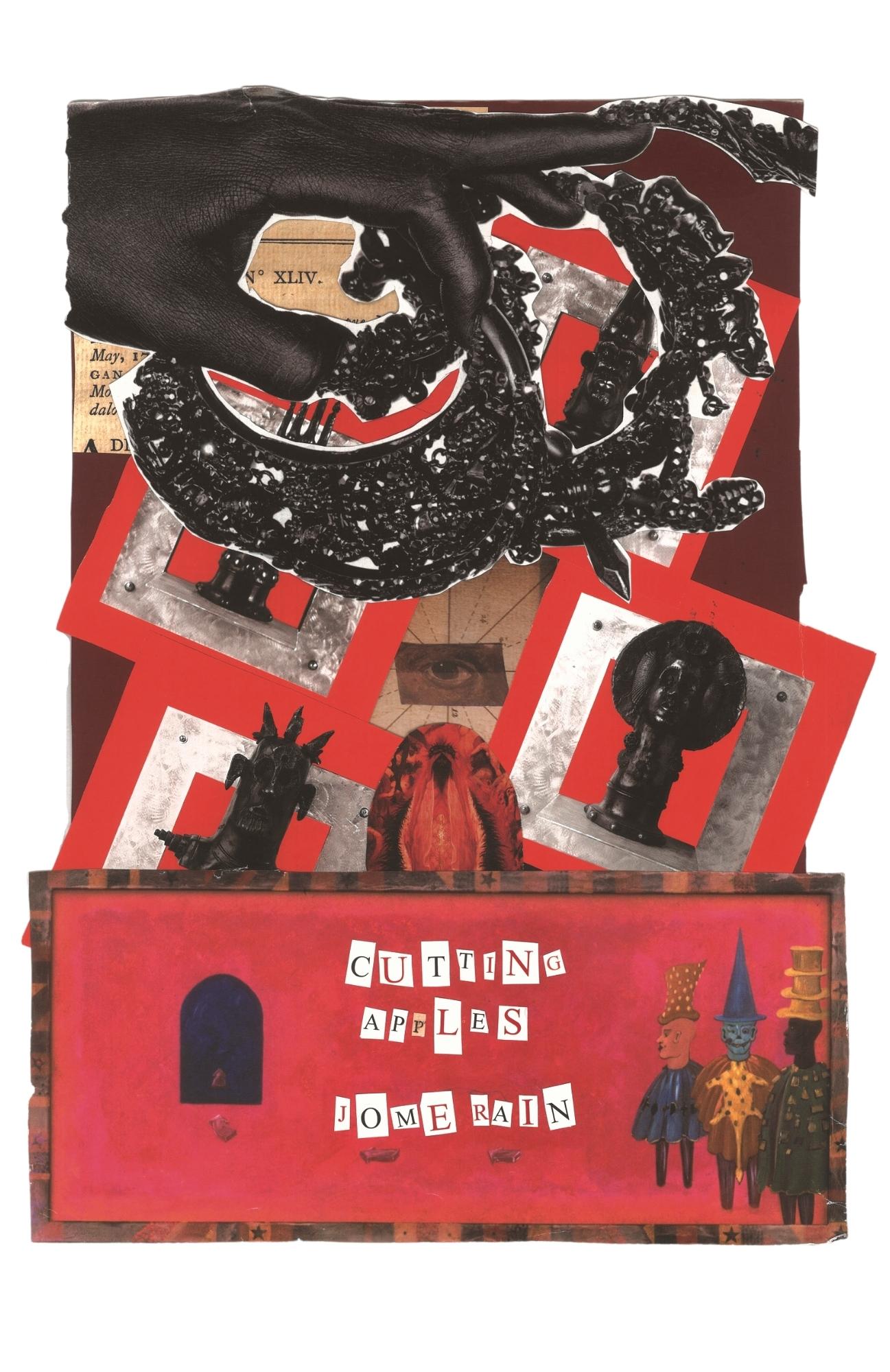
NetGalley Review: Cutting Apples by Jome Rain

Cutting Apples by Jome Rain is a jewel of a book. Rain’s stream of consciousness writing style may at first seem like an odd approach for a memoir, but it is perfect for this piece, one that was written during an odd time as the world struggled to make sense of COVID-19. Rain’s memoir is written as an undated, ongoing letter to an unnamed love, a love not quite lost, but you feel the fragility of this relationship. Rain allows herself to be vulnerable, she tells her readers her fears, her heartaches, her insecurities and her hopes. She invites readers to witness a very personal analysis of her relationship with her mother; I found this quite affecting in its complete oppositeness to my own relationship with my mother. In reading Rain’s memoir, I was driven to my own contemplation of the relationships in my life. Therein lies the power of this memoir, I think. Jome Rain has crafted an engaging book, opening herself to strangers to see her most private thoughts, and causing them to step away and look within themselves. I have read few memoirs that have caused me to do this. I cannot recommend this book enough. You will find yourself stopping to reread lines, to consider how they relate to your own experience. It will cause you to look within and consider what you have thought to be absolute.