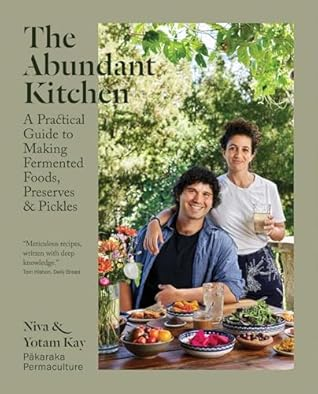
NetGalley Review: The Abundant Kitchen

Thank you NetGalley and Skyhorse Publishing for the ARC of Niva and Yotam Kay’s “The Abundant Kitchen!”

For a long time now, I have wanted to learn how to can my own vegetables and make my own jams and kombucha, but I am terrified I am going to give my family botulism. This book almost has me convinced I can make my own fermented and preserved foods. The instructions are step by step and include tips on what to look out for to prevent spoilage (or worse). Also, the recipes sound delicious! Rose-Honey Dairy-Free Yogurt? Yes, please. Rose-Lavender and Apple-Mint Kombucha? I’ll take two. And my whole household will appreciate homemade ginger beer. (Don’t even get me started on the mead!)


There is a recipe for pickled butternut squash…I have never heard of that. In fact, I wasn’t aware that you could pickle butternut squash. Beans, cucumbers, beets, onions, even watermelon rind I knew of. And of course, cabbage as sauerkraut and kimchi, both family favorites. At present, the only fermentation I am comfortable with is sourdough. I tend to have a sourdough starter in my refrigerator for a year or so, then end up killing the poor thing by not feeding it. (I take much better care of my cat, I promise.) The Kay’s Sourdough Honey Challah will be the first recipe I try with my new starter.


When I got to the section on making your own miso I knew I had to get a printed copy of this book. Trying to follow a recipe on a Kindle is tricky at best, and I like to add Post-It notes to my cookbooks with my thoughts (or notes on what I did wrong…). This book even has a section on curing meat, which my husband will love. In fact, I may need to buy two and gift one to my sister the chef.


This book is fantastic and will absolutely be added to my cookbook collection. Maybe I’ll even be brave enough to use it!
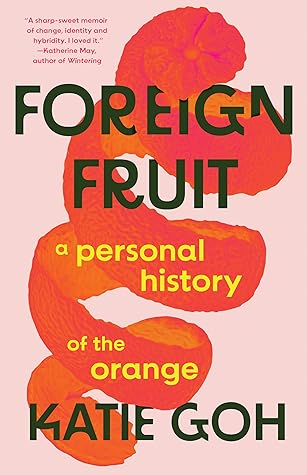
NetGalley Review: Foreign Fruit by Katie Goh

Foreign Fruit by Katie Goh is an outstanding book. I was expecting a microhistory about oranges, or citrus fruit as a whole; I was not expecting an incredibly well-researched social history about culture, society, belonging, searching for one’s place in the world, biases, acceptance, food cultivation, and environmentalism (among other topics). Goh’s book takes readers from Ireland and Malaysa to China, Italy via the Silk Road, France, Russia, and the United States. Readers witness the destructive oppression of Dutch and British colonialism, Communist tyrants, and violent racism. I had never heard of the Los Angeles Riot of 1871, in which nineteen Chinese immigrants were murdered, and no one was held accountable.

Readers are also introduced to the wonders of citrus cultivation; I was also unaware that similar to apples, citrus seeds will not grow true to the parent plant: if you plant a clementine seed you will get some kind of variety of citrus, possibly even a clementine (but don’t count on it). Goh tells us of the origins of many of the citrus varieties we are familiar with today, how the fruit rose to such popularity (aside from being delicious), and its cultural significance in many cultures.

In a fashion similar to Crying in H Mart and My Berlin Kitchen, Goh describes a childhood of feeling like an outsider, growing up in Ireland as the child of an Irish mother and a Chinese-Malaysian father. Her love of her heritage is evident despite her inner struggle to see just where she fits in. Her descriptions of visits to her family in Malaysa are filled with warm childhood memories, and when she returns as an adult she is just as eager to embrace her culture and identity.

This book was a pleasure to read, engaging, informative, completely engrossing. I highly recommend this as a memoir, a microhistory, and as a study of society.